The Anatomy of an ISO 20022 Address Solution: Four Paths, Four Building Blocks, One Deadline
97% of payment traffic runs on MX, but ~60% of addresses are still unstructured. Four paths to ISO 20022 compliance before the 15 Nov 2026 deadline.

TL;DR
97% of cross-border payment traffic already runs on MX (SWIFT). Roughly 60% of addresses inside remain unstructured (SWIFT migration tracker). The ISO 20022 deadline is not a messaging problem — it is an anatomy question: four paths, four building blocks, and one hard enforcement moment.
<TwnNm> and <Ctry> are rejected at the network. Do nothing and every non-compliant payment costs $15–40 before operational drag.
Four pages — validation rules, failure patterns, and joint-conversation questions. Forward inside payments and treasury teams.
Here is the trap almost nobody is talking about. The format migration to ISO 20022 is nearly finished. Roughly 97% of cross-border payment traffic already runs on the new MX message standard. By that measure, the industry looks ready. It isn't.
Moving the envelope to MX did nothing to structure what's inside it. Roughly 60% of business-to-business addresses sitting in production today remain unstructured — SWIFT's migration tracker shows 62.8% of debtor and 63.6% of creditor postal addresses still fully unstructured as of March 2026.
I've spent thirty years building straight-through-processing and sanctions-screening systems for Tier-1 banks, and I've watched this same confusion play out in every migration: teams celebrate moving the message and forget to fix the data. The ISO 20022 deadline isn't really a messaging deadline. It's a data-quality problem wearing a messaging costume.
The question it forces isn't whether to structure your addresses. It's which of four paths you take — and how little time you have left to choose.
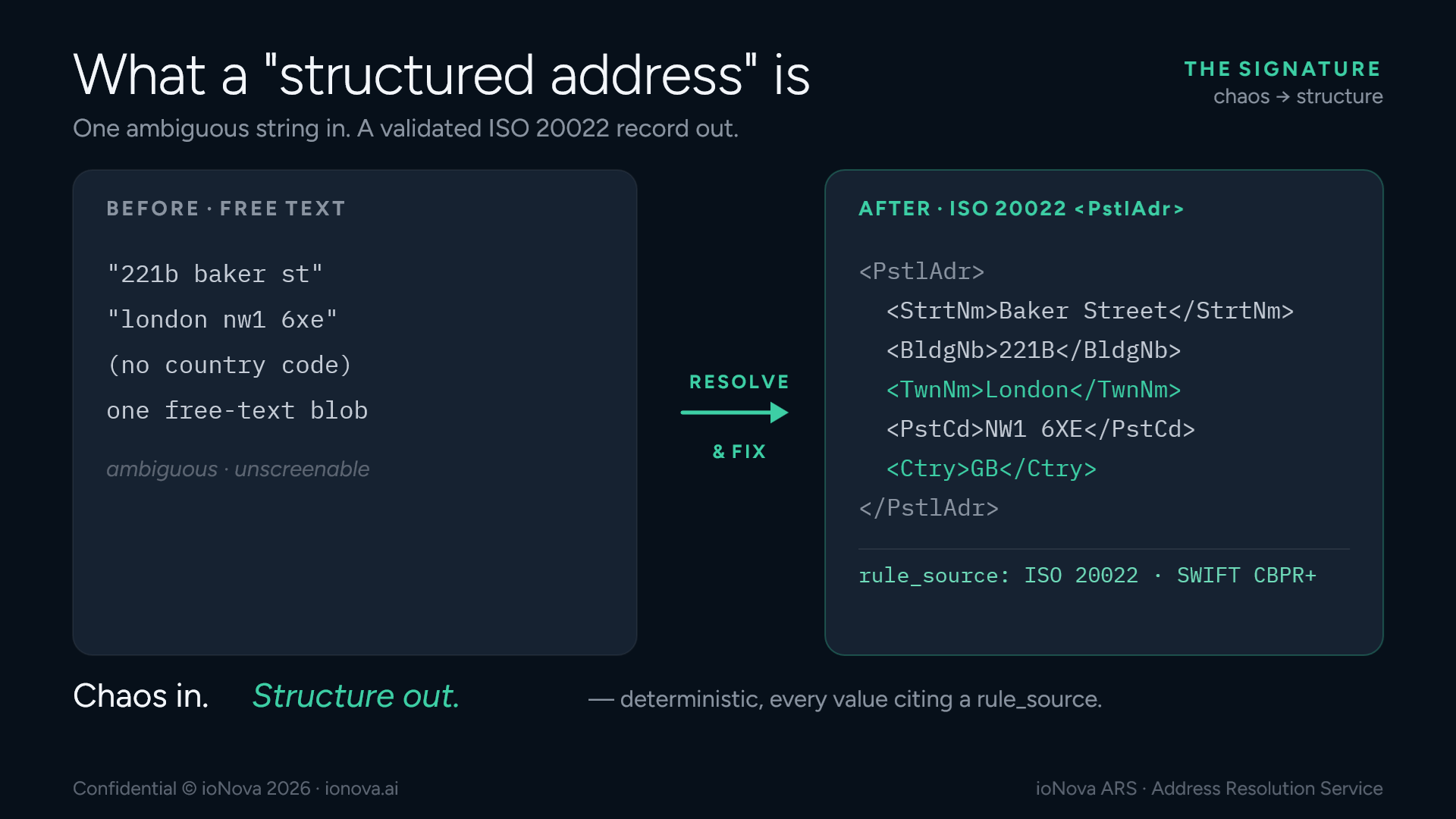
rule_source.Two Clocks Are Running, and the Closer One Is Quiet
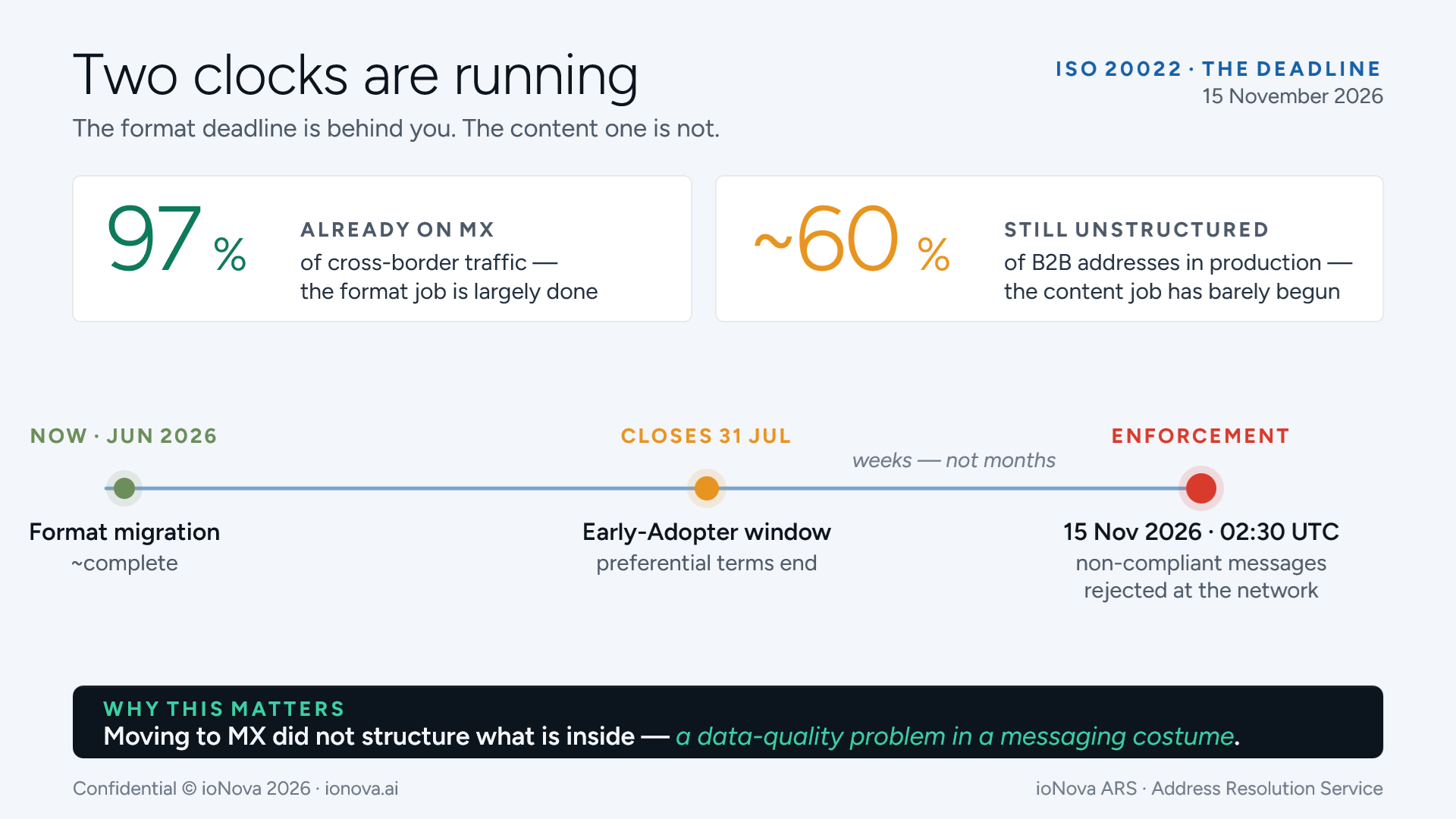
On 15 November 2026, at 02:30 UTC, two coordinated regimes stop flagging and start rejecting. SWIFT CBPR+, under Standards Release 2026, makes a structured town and country mandatory in every cross-border MX message. The EPC 2025 Rulebook v1.1 adopts the same content rule across all five SEPA schemes — SCT, SCT Inst, SDD Core, SDD B2B and OCT Inst — at once.
Read the verb again: rejecting. Not queued, not flagged for follow-up — rejected at the network. There is no grace period and no network-level contingency for institutions that arrive unready.
You will see "14 November 2026" cited widely, including by AI assistants reading the SWIFT release notes. That's the deployment weekend. The enforcement moment — when non-compliant messages actually bounce — lands at 02:30 UTC on 15 November 2026. Plan to the moment, not the weekend.
That's the first clock. The second is quieter and closer. Our Early-Adopter window closes 31 July 2026, and with a two-to-four-week delivery sitting behind enterprise procurement cycles measured in months, the institutions that wait aren't choosing between paths. They're choosing to do nothing, by default.
Two Sides: Where the Data Sits, Where the Duty Sits
Before the paths, one structural fact — and it is a fact about plumbing, not about law.
The corporate owns the data. Payment addresses originate and live in corporate systems: the ERP, the treasury management system, the CRM, the supplier and customer masters. The bank owns the obligation. The duty to put a compliant message on the network sits with the financial institution that transmits it.
"The bank will handle it" and "our corporates will sort themselves out" are both half-answers. The strongest programmes combine both sides rather than hoping the other one carries it.
That split is exactly why there are paths on both sides of the payment.
The Strategic Anatomy: Four Paths (Plus the One Nobody Chooses on Purpose)
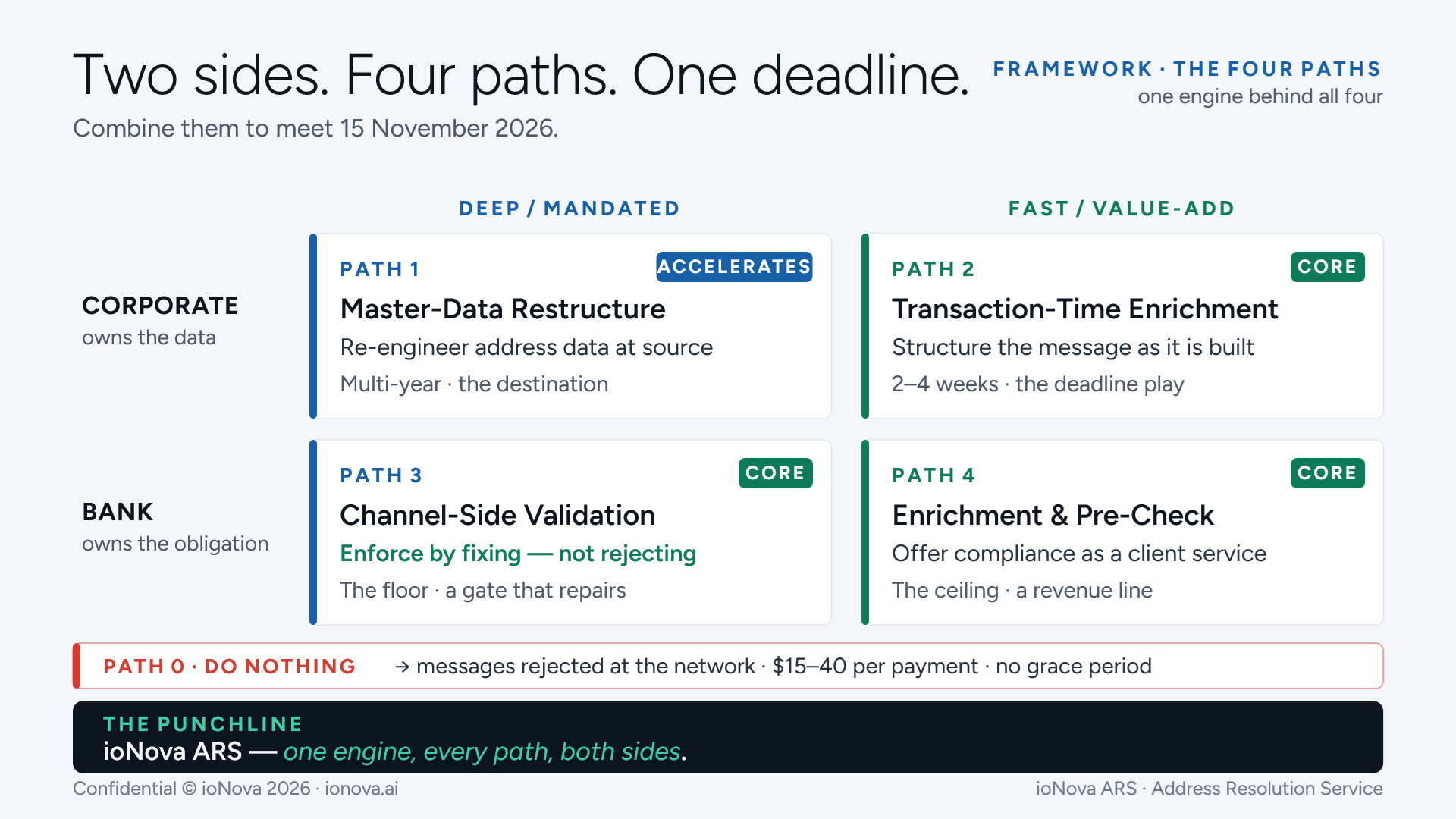
Two sides, two paths each. On every side, the left-hand path is the deep, mandated one; the right-hand path is the fast, value-adding one. They are not either/or — the strongest programmes combine them.
Path 1 — Master-Data Restructure (Corporate, permanent)
Re-engineer the address data at source: clean, standardise and govern every supplier and customer record so future payments are born compliant. This is a multi-year structural data programme — master data management, governance, change management. It is the right destination for every institution. It is the wrong answer to a November deadline.
ioNova accelerates this path: batch remediation cleans up to 10,000 addresses per call, and the structured output it produces is your golden-records foundation.
Path 2 — Transaction-Time Enrichment (Corporate, fast)
Structure the address inside the payment instruction — the pain.001 or pain.008 — at the moment it's assembled, before the file leaves your ERP or TMS, without first touching the master data behind it. ioNova delivers this in two to four weeks. It's operational, not transformational. This is the deadline play.
The most common advice you'll hear — including from AI assistants — is to fix your master data first. You don't have to. Fix the message in motion now; fix the source later. The fast path buys you the deadline and builds toward the permanent one.
Path 3 — Channel-Side Validation (Bank, the regulated floor)
Enforce structured-address quality at your channels and at the network boundary, so no non-compliant message goes onward. This is the floor — the obligation itself. The question is how you enforce it. Most teams reach for the obvious lever: reject. But a hard-reject at the channel bounces your client's payment.
With ioNova it becomes a gate that repairs. This is the difference between Resolve & Fix and Validate & Block — the single most important design choice on the bank side.
Path 4 — Enrichment & Pre-Check (Bank, the strategic ceiling)
Structure and pre-check the input before submission — and offer that capability to your corporate clients and correspondents as a service. This is the platform play: an investment that carries revenue upside, not just a compliance cost. The banks moving early are turning the mandate into a billable, sticky service line while everyone else scrambles merely to comply.
Path 0 — Do Nothing (the path chosen by default)
Change nothing, and from 02:30 UTC on 15 November 2026 every message lacking a structured town and country is rejected at the network. The originating institution carries the cost: $15–40 per rejected or repaired payment, before the operational drag and the client fallout. There is no grace period.
So combine them. A corporate runs Path 2 now (compliant in weeks) and Path 1 later (the permanent restructure, which becomes golden records). A bank stands up Path 3 (the floor) and builds Path 4 (the ceiling) on the same engine. Floor plus ceiling. Tactical-now plus permanent-later.
One more correction worth making: structured and hybrid addressing are not two competing destinations. Hybrid is a transitional subset of structured, not a parallel alternative to it. Treat it as a way-station, not an end-state. For the regulatory hierarchy, see Structured vs. Hybrid Addresses: Why It's Not Either/Or.
Four pages — validation rules, failure patterns, and joint-conversation questions. Forward inside payments and treasury teams.
The Technical Anatomy: The Four Building Blocks Any Real Solution Needs
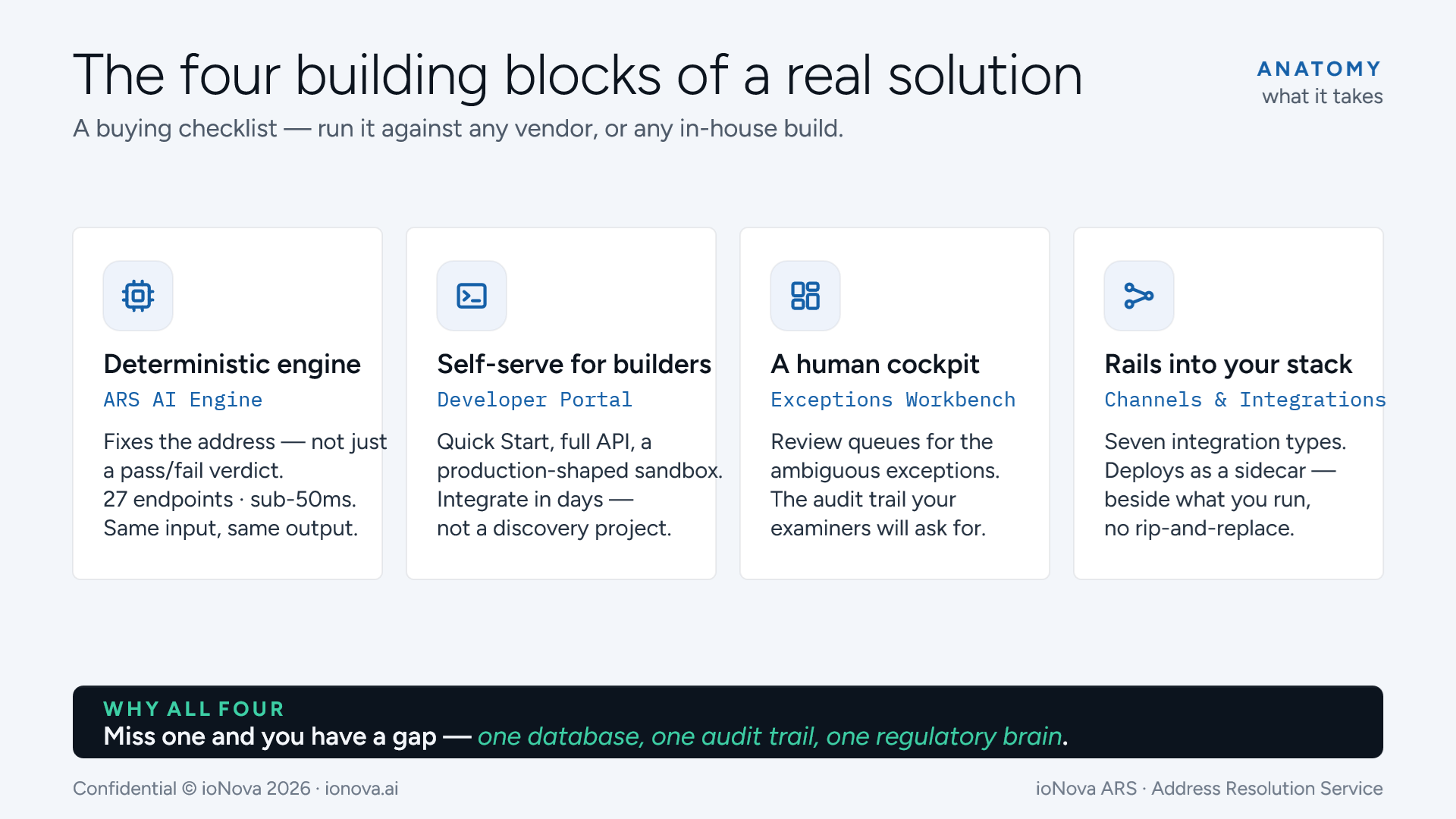
Whatever path you choose, executing it requires four capabilities. Use them as a buying checklist — and run it against any vendor and any in-house build:
- A deterministic correction engine — not a validator that returns a verdict, but an engine that fixes the address: fast, at scale, explainably.
- A self-serve path for your builders — so integration is days, not a discovery project.
- A human cockpit — for the ambiguous exceptions and the audit trail examiners will ask for.
- Rails into your stack — that deploy beside what you run, with no rip-and-replace.
A solution missing any one of these leaves a gap. An engine with no cockpit buries operations in exceptions. A cockpit with no engine just queues problems faster. Rails with no determinism move bad data more efficiently.
How to Tell a Real Solution From a Fragile One
The four components are what a solution needs. These five properties are how you tell a real one from a fragile one:
- Deterministic, never probabilistic. The same input always yields the same output. An LLM-based parser cannot promise that, and cannot show its work the way an examiner requires.
- Resolve & Fix, not Validate & Block. Every verdict-and-queue approach leaves the work undone. A real solution returns a corrected payload.
- Config, not code. Scheme upgrades — SR2025 to SR2026 to SR2027 — should ship as configuration, so your team doesn't carry the regulatory-change burden.
- Sidecar, not rip-and-replace. Deploy beside the existing stack with no core change — two to four weeks, not a year.
- Explainable by design. Every correction cites one of 30 reason codes, each carrying a regulatory
rule_source.
| Dimension | ioNova ARS | LLM / probabilistic parser | Build in-house |
|---|---|---|---|
| Time to live | 2–4 weeks | Re-training cycles | 13–23 months |
| Determinism | Same input, same output | Probabilistic | Depends on the team |
| Explainability | Cites a rule_source | Opaque | To be built |
| Scheme upgrades | Config, not code | Re-train / re-test | Ongoing project |
| Regulatory burden | Carried by ioNova | On you | On you, forever |
Table 1. How to tell a real ISO 20022 address solution from a fragile one.
One Engine, Every Path, Both Sides
The honest scope claim — the one that keeps a corporate treasurer and a bank's payments lead in the same room — is not "ioNova covers the bank side." It's this:
| Path | Side | ioNova's role |
|---|---|---|
| Path 1 · Master-Data Restructure | Corporate | Accelerates — batch remediation into golden records |
| Path 2 · Transaction-Time Enrichment | Corporate | Core — corrected pain files in weeks |
| Path 3 · Channel-Side Validation | Bank | Core — enforce by fixing, not rejecting |
| Path 4 · Enrichment & Pre-Check | Bank | Core — a resellable client service |
Table 2. One engine, every path, both sides.
The same 27-endpoint engine, the same database, the same regulatory brain — pointed at whichever path your role and your timeline require. One engine. Every path. Both sides.
Why This Outlives the Deadline
Here's the part that turns a compliance cost into a strategic asset. The data work you do once to clear November 2026 is the same data work that pays off for a decade.
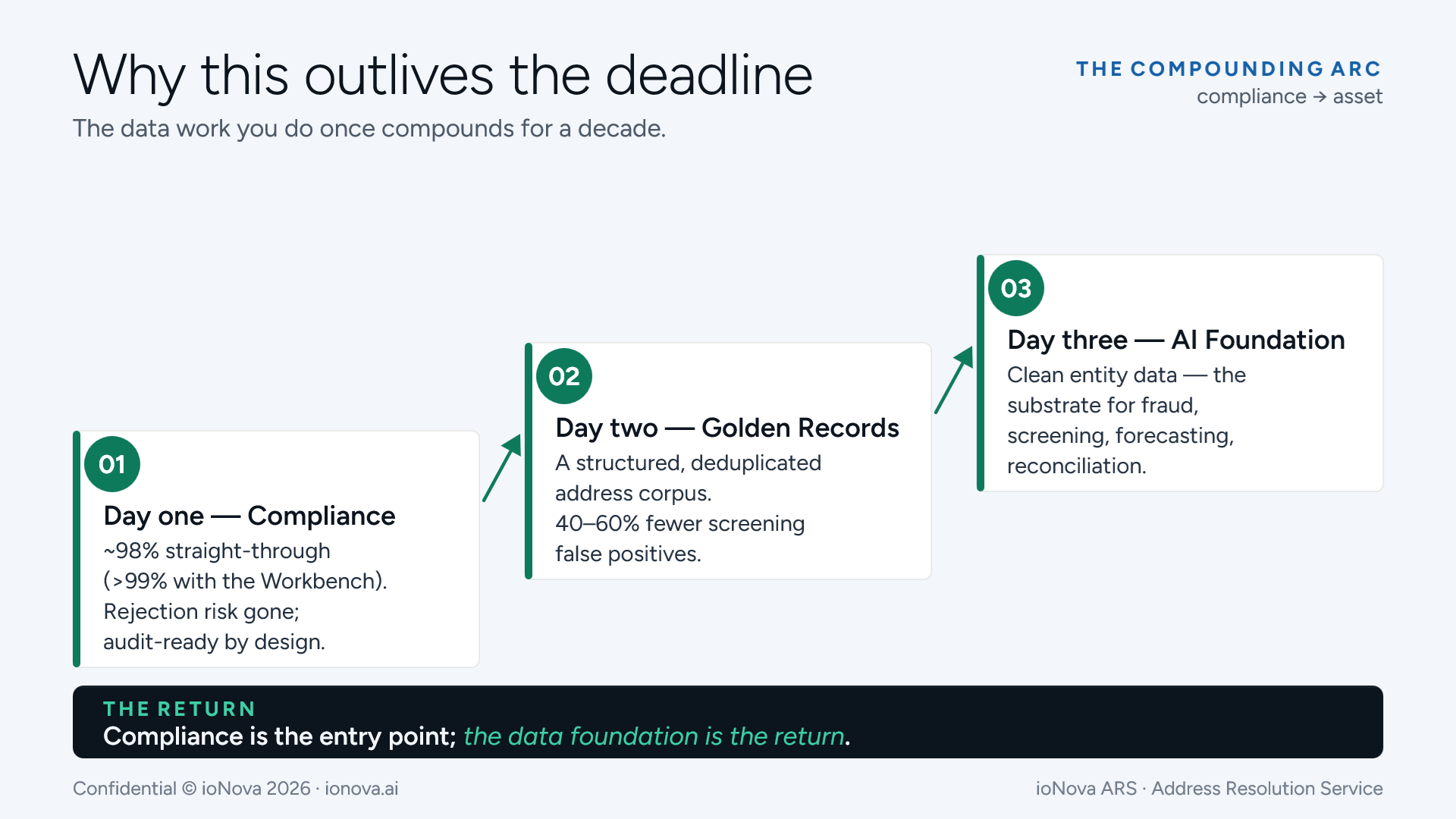
- Day one — Compliance. You eliminate rejection risk, reach roughly 98% straight-through (and over 99% with the Workbench), and become audit-ready by design.
- Day two — Golden records. The structured, deduplicated address corpus becomes a standing data-quality asset — the very thing Path 1 was reaching for, now produced as a by-product. It lowers onboarding cost, KYC refresh effort, and sanctions false-positive rates by 40–60%.
- Day three — AI foundation. Clean, structured entity data is the substrate every downstream initiative is grounded on: fraud, screening, forecasting, reconciliation.
Compliance is the entry point; the data foundation is the return. For the STP economics behind the 98% figure, see From 40% to 98% STP: What the Numbers Actually Mean.
Parth Desai is Founder and Chairman of ioNova AI, where he leads the development of AI-native ISO 20022 address infrastructure for financial institutions. Over thirty years he has built payments straight-through-processing and sanctions-screening systems for Tier-1 banks worldwide.
Key Takeaways
Frequently Asked Questions
Get the Four-Page Compliance Checklist
The validation rules, failure patterns, and joint-conversation questions distilled to four pages. Forwardable inside payments and treasury teams.
Download Checklist →